


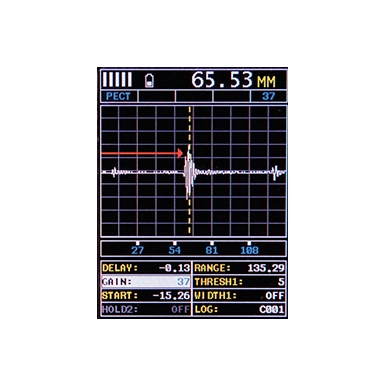
Among the measurement modes available on the Dakota NDT instruments of the CMX series, PECT (Pulse-Echo Coating Through) mode is often the least known but one of the most useful in demanding industrial applications. Its purpose is to allow simultaneous measurement of the thickness of the coating and of the material beneath it in a single reading, giving two pieces of information that other modes cannot provide.

An overview of the CMX measurement modes
According to the official Dakota datasheet for the CMX series (CMX1-DL, CMX2-DL, CMX3-DL, CMX10-DL), the available measurement modes are:
- PE (Pulse-Echo): standard mode, measures the total (including any coating present)
- EE (Echo-Echo / ThruPaint™): ignores coating up to 2 mm, measures the metal only
- PETP (Pulse-Echo Temperature Compensation): automatically compensates for temperature variations during the measurement
- CT (Coating Only Mode): measures the thickness of the coating only
- PECT (Pulse-Echo Coating Through): measures coating and underlying metal at the same time in one reading

Need help choosing the right product?
What PECT mode is

PECT mode uses the different speed of sound in the coating and in the metal to separate the two contributions within a single measurement. The instrument analyses the sequence of echoes: the echo from the coating-metal interface and the back wall echo. From the time intervals between the echoes it calculates separately:
- the thickness of the coating (typically paint or epoxy)
- the thickness of the metal beneath
- and at the same time any intermediate flaws such as pitting, delamination or inclusions
The official Dakota datasheet presents the CMX series as able to “measure coatings and material thickness simultaneously while maintaining the ability to locate pits, flaws and defects in the material”.
When PECT mode is indispensable

PECT mode is preferable, or indispensable, in these scenarios:
Inspecting corrosion under coating
On piping or tanks with a protective coating it matters to know both things at once:
- whether the coating is intact (thickness within specification)
- whether the metal beneath the coating has corroded
Without PECT this would take two separate measurements (CT for the coating plus EE for the metal); with PECT a single reading gives both.
Monitoring pitting under coating
Localised pitting under a coating is hard to detect: PECT mode makes every anomalous echo in the metal region visible at once, flagging potential localised flaws that other modes would miss.
Checking active protection
Where maintenance of coated surfaces calls for both the condition of the coating (degradation, ageing, detachment) and that of the metal to be checked, PECT gives the complete picture needed to decide whether the coating has to be made good or whether the problem is more serious (active corrosion under intact paint).
Inspecting coated tanks and vessels
Many chemical storage tanks have an internal resin lining for chemical protection. PECT mode is useful for checking at the same time:
- the integrity and thickness of the internal protective lining
- the remaining thickness of the steel shell
When PECT is not needed
PECT mode is not always required. In some cases a simpler mode is enough:
- Bare metal surfaces: use standard Pulse-Echo
- Only the metal matters (not the coating): use Echo-Echo ThruPaint™
- Only the coating matters: use Coating Only Mode (CT)
- Instruments other than the CMX: PECT is not available on the CX, ZX and MX models, but ThruPaint™ covers most practical cases
Dakota instruments that support PECT
According to the official specifications, PECT mode is available on the following Dakota instruments:
- Dakota CMX1-DL, CMX2-DL, CMX3-DL: the CMX series with A-Scan
- Dakota CMX10-DL: top of the range with Full Wave Capture
- the FX70-DL / FX71-DL / FX81-DL flaw detectors: they include advanced modes that cover the PECT functions within flaw detection
Points to watch in practice
- Specific calibration: PECT mode requires the speed of sound of both the coating and the metal to be entered
- Condition of the coating: degraded, blistered or delaminated coatings can give confused echoes
- Coating thickness limit: check the instrument specifications for the upper limit of coating that can be measured
- Interpretation with A-Scan: in PECT mode it is always advisable to check the signal on the A-Scan for visual confirmation that the echoes are correct
To go further into the applications of PECT mode and choose the most suitable CMX instrument, contact our technical department.