


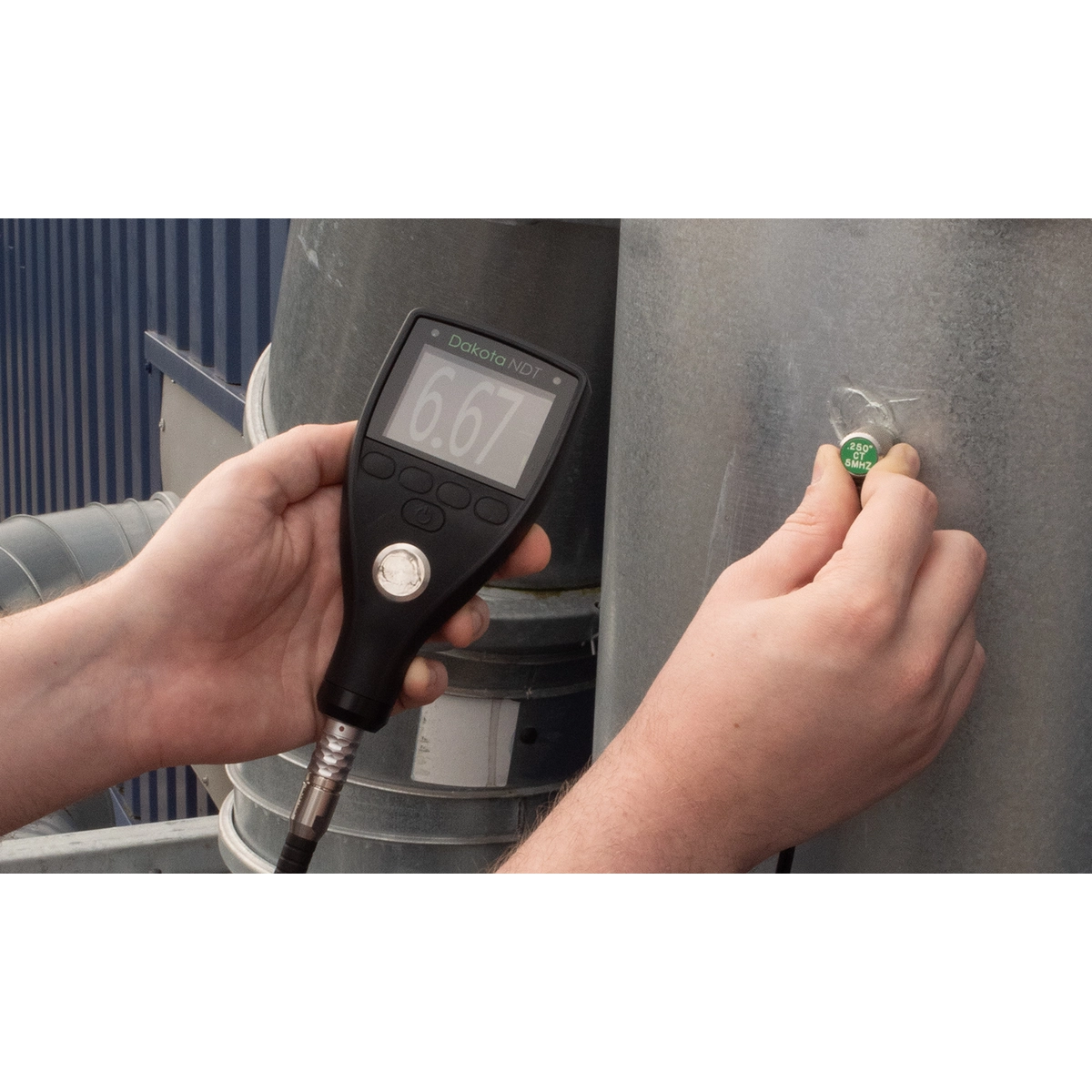
In the oil & gas sector and in the maintenance of process plants, two American codes from the American Petroleum Institute have become the international reference for integrity inspections: API 570 for in-service piping and API 653 for atmospheric storage tanks. Both set stringent requirements for ultrasonic thickness measurement instrumentation, which the Dakota NDT instruments of the CMX, MX and PCX series are designed to meet.

API 570 — Piping Inspection Code
API 570 “Piping Inspection Code: In-service Inspection, Rating, Repair, and Alteration of Piping Systems” is the international reference code for the inspection, rating, repair and alteration of in-service piping in refineries, petrochemical plants and hydrocarbon processing facilities. Its main contents:
- Classification of piping by criticality (service classes)
- Minimum requirements for periodic inspection programmes
- Inspection intervals according to service class and operating conditions
- Permitted NDT methods, including ultrasonic thickness measurement
- Acceptance/rejection criteria for calculated minimum thicknesses
- Repair and re-qualification procedures after work
- Qualification of inspection personnel (API 570 Authorized Inspector)

Need help choosing the right product?
Instrumentation requirements for API 570
To carry out API 570-compliant inspections, the instrument must meet precise practical requirements:
- Metrological accuracy adequate for calculating the minimum allowable thickness (tmin)
- Data logger with structured grids to record measurements repeatably at the same locations (CML – Condition Monitoring Locations)
- Ability to measure on corroded, coated and high-temperature surfaces (dedicated high-temperature probes)
- Echo-Echo ThruPaint™ mode to measure through protective paint without removing it
- Calibration traceable to recognised metrology bodies (NIST or equivalent)
- Professional reporting compatible with the company’s asset integrity management systems
The Dakota instruments best suited to API 570 inspections are the CX8-DL, the CMX1-DL/CMX3-DL, the MX1-DL/MX2-DL and the top-of-the-range CMX10-DL, all equipped with a structured data logger and DakMaster™ integration for reporting.

API 653 — Tank Inspection, Repair, Alteration and Reconstruction
API 653 “Tank Inspection, Repair, Alteration, and Reconstruction” is the parallel code devoted to welded steel atmospheric storage tanks. It covers tanks built to API 650 (new) or API 12C (older) and sets the requirements for in-service inspection. Its main contents:
- Types of inspection: internal, external, bottom, shell, roof
- Minimum inspection intervals according to the service and history of the tank
- Permitted NDT methods for each component (thickness, welds, bottom)
- Acceptance criteria for the remaining thickness of shell and bottom
- Calculation of the remaining service interval (remaining life)
- Repair, alteration and reconstruction procedures
Instrumentation requirements for API 653
API 653 inspection poses specific challenges for the instrumentation:
- Intensive mapping of large surfaces (shells tens of metres across): high-speed scan mode is required (up to 250 readings/sec on the MX and CMX models)
- Storage of large volumes of data: the 4 GB memories of the MX and CMX models are sized for complete campaigns
- Ability to work on external coatings: the protective paint on tanks must not be removed; Echo-Echo ThruPaint™ mode is indispensable
- Measurement on heavily corroded surfaces: dual element probes and PECT mode for materials with pitting
- A-Scan display to validate the soundness of critical measurements (available on the CMX, MX2-DL and higher models)
- Integration with reporting software: DakMaster™ handles measurement grids for shell and bottom

Dakota instrument selection matrix for API 570 / API 653
| Application | Recommended Dakota instrument | Rationale |
|---|---|---|
| Spot inspection of small piping | CX8-DL | Basic data logger, ThruPaint™, economical |
| Intensive piping mapping | CMX1-DL / CMX3-DL | A-Scan, 4 GB, 250 Hz scan |
| Tank shell mapping | MX2-DL / CMX3-DL | B-Scan, A-Scan, fast scan |
| Piping with PECT for corrosion under coating | CMX3-DL / CMX10-DL | PECT mode, full waveform |
| Critical applications with full reporting | CMX10-DL | Top of the range with second layer waveform |
Personnel qualification
Both API codes require inspections to be carried out by personnel qualified under recognised certification schemes. In Europe the EN ISO 9712 Level 2 UT qualification is common, while API directly recognises the API 570 Authorized Piping Inspector and API 653 Authorized Aboveground Storage Tank Inspector certifications. A compliant instrument is a necessary but not sufficient component: operator qualification is an equal requirement.
For advice on the Dakota NDT instrumentation best suited to Your API 570 and API 653 procedures, contact our technical office.