


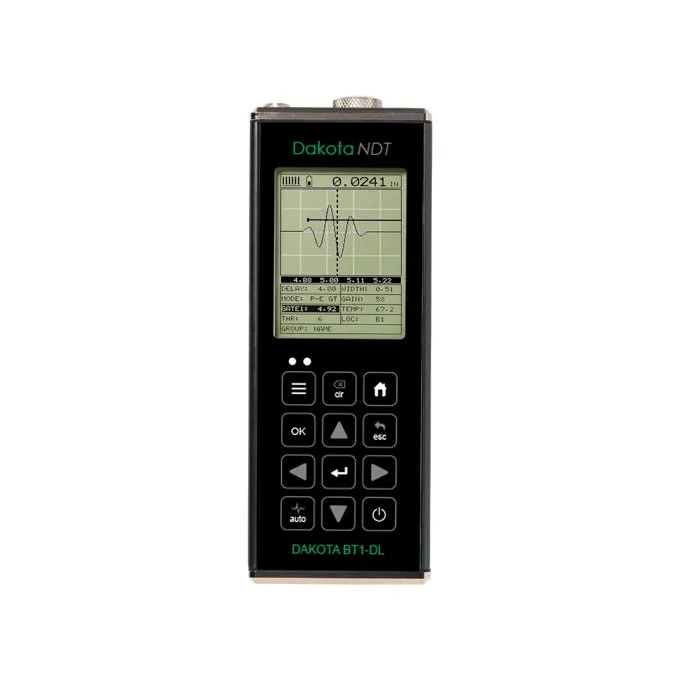
Modern wind turbines reach heights of more than 150 metres, with blades of 70-90 metres and outputs of up to 15 MW in the latest offshore versions. Structural integrity depends critically on the correct tension of the foundation, tower joint and blade root bolts. Ultrasonic measurement with the Dakota BT1-DL and BT2-DL is the reference method for the controlled tightening and periodic monitoring of these critical structural connections.

The critical bolted connections of a wind turbine
On a modern wind turbine the main bolted connections carrying high structural responsibility are:
- Foundation bolts (anchor bolts): anchorages to the reinforced concrete base or, offshore, to the monopile or jacket. Typically M48-M72 in high-strength steel, from 1.5 to 3 metres long
- Tower section joints: modern towers are assembled from several sections (typically 3-5), each connected to the next by a bolted flange with typically 100-140 M36-M48 bolts
- Nacelle connection at the top of the tower (yaw bearing bolts)
- Rotor (hub) connection to the main shaft
- Blade connection to the hub (blade root bolts): dozens of bolts per blade, under cyclic fatigue loading
- Gearbox and generator flanges

Need help choosing the right product?
Why ultrasonic measurement is the method of choice
Wind turbines bring together every reason to prefer ultrasonic measurement over traditional torque control:
- Cyclic fatigue loading: every rotor revolution (up to 20 rpm) produces a stress cycle; over a 20-year life that is hundreds of millions of cycles. An under-sized initial tension rapidly leads to fatigue failure
- Very high cost of failure: the failure of a blade root bolt can cause a blade to detach — a potentially catastrophic event
- Limited accessibility: the bolts are often in positions that are hard to inspect, and corrective work after installation is expensive
- Temperature variation: turbines operate across wide temperature ranges (from -30 to +50 °C); the automatic temperature compensation of the Dakota BT is essential here
- The need for monitoring over time: ultrasonic measurement makes it possible to check the residual tension on the same bolt after years in service
- Manufacturer-specific requirements (Vestas, Siemens Gamesa, GE, Nordex, Enercon) prescribe tightening procedures with tension control
Dakota BT applications on wind turbines

Initial tightening at installation
During the installation of a new turbine, the tightening sequence for the foundation and tower joint bolts follows precise manufacturer procedures. The Dakota BT1-DL is used to:
- measure the initial (zero-load) length of each bolt before tightening
- follow the elongation during progressive tightening (30%, 70%, 100% of target)
- verify the final tension at the end of the procedure
- go round again after the bedding-in time defined by the manufacturer (typically 24-72 h)
- record the final tension of each bolt in the commissioning report
Periodic monitoring
Preventive maintenance calls for periodic checks (typically annual) of the tension in the critical bolts. The Dakota BT1-DL makes it possible to:
- re-measure the length of the installed bolts and compare it with the original length
- calculate the residual tension and compare it with the allowable range
- identify bolts with abnormal relaxation that need re-tightening
- keep a historical record of the condition of each bolt through the data logger and DakMaster™
What is specific to offshore wind
Offshore installations add further complexity:
- Large anchor bolts to the monopile or the transition piece (M64-M80)
- A corrosive marine environment that accelerates relaxation if the installation tension is not right
- High operating costs for inspections by vessel or helicopter
- The need for rigorous documentation for asset owners and regulatory authorities
For very long anchor rods (beyond a few metres) the Dakota BT2-DL may be the right choice: according to the official data sheet it measures fasteners up to 30 metres.
Recommended workflow
For the maintenance of a wind farm, good practice is to:
- record the reference length of every bolt at installation, with a unique identifier
- store all the data in DakMaster™, organised by turbine, tower section and flange position
- set a schedule of periodic checks consistent with the manufacturer’s recommendations
- define alarm thresholds on the allowable residual tension (typically 80-85% of the initial value)
- document every inspection with an automatic DakMaster™ report for traceability
For advice on applying the ultrasonic method to Your wind farm, contact our technical department.