


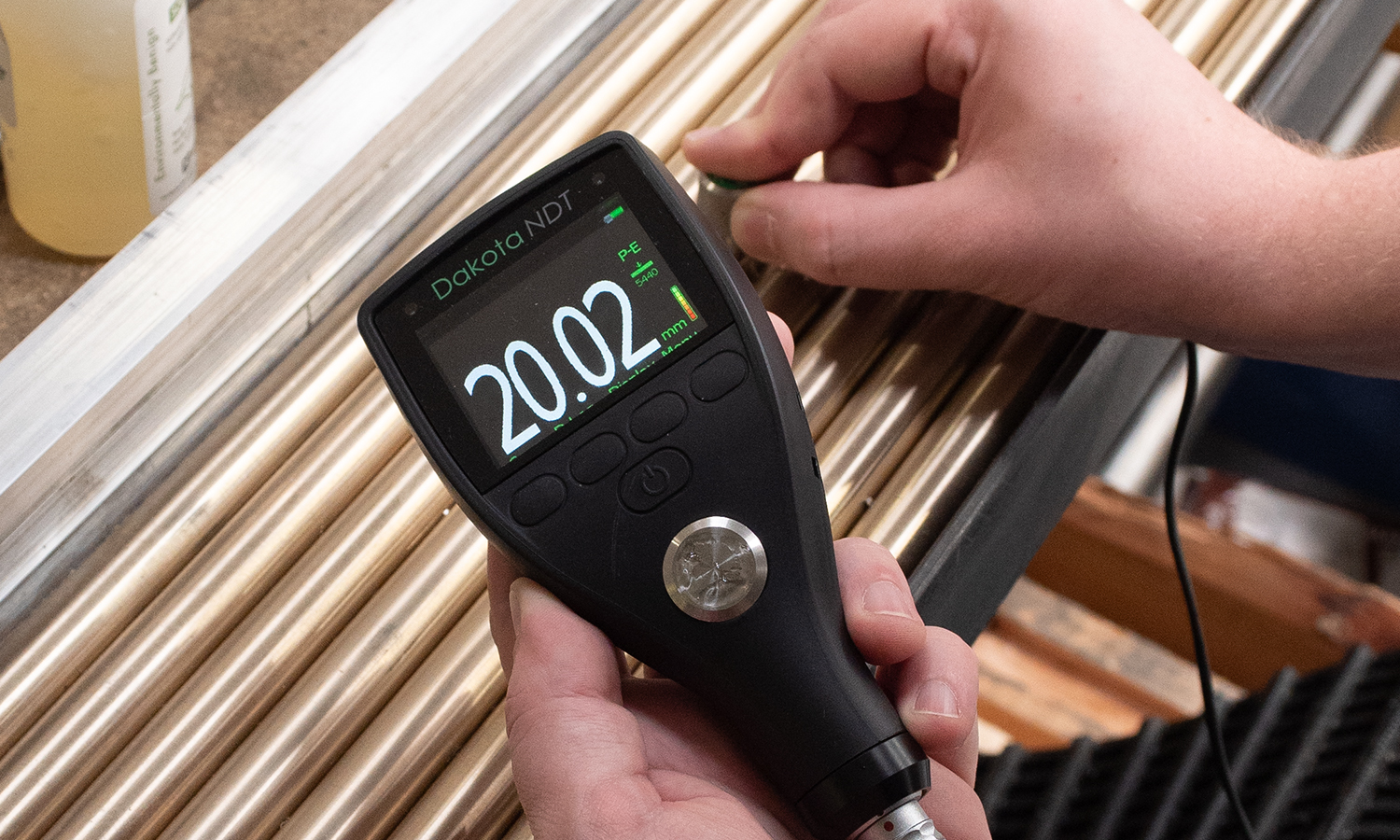
Ultrasonic thickness measurement is governed by a set of international standards that define the requirements for instruments, procedures and personnel qualification. The three most important standards for Dakota NDT instrumentation are EN 14127 (European), ASTM E797 (American) and EN 15317 (European, on flaw detectors). All Dakota gauges of the CX, ZX, MX and CMX series are declared by the manufacturer to comply with these standards.

EN 14127 — Ultrasonic thickness measurement
EN 14127 “Non-destructive testing — Ultrasonic thickness measurement” is the harmonised European standard that defines the requirements for ultrasonic measurement of material thickness. The standard covers:
- Principles of ultrasonic thickness measurement by the Pulse-Echo method
- Characteristics and classification of measuring instruments
- Requirements for probes (transducers) and their accessories
- Calibration and adjustment procedures
- Factors affecting measurement accuracy
- Methods for verifying instrument performance

Need help choosing the right product?
EN 14127 compliance is a typical requirement in European inspection specifications and in NDT personnel qualification procedures to EN ISO 9712. The Dakota CX, ZX, MX and CMX series gauges are declared by the manufacturer to comply with this standard.
ASTM E797 — American standard for thickness measurement
ASTM E797 “Standard Practice for Measuring Thickness by Manual Ultrasonic Pulse-Echo Contact Method” is the American standard practice published by the American Society for Testing and Materials. It is widely recognised internationally and cited in the specifications of industries with a North American presence (oil & gas, aerospace, power generation). The standard deals with:
- Practice for manual thickness measurement by the contact Pulse-Echo method
- Selection and verification of the instrumentation
- Preparation of the measurement surface
- Calibration procedure with reference blocks
- Handling of operating variables (temperature, coupling, geometry)
- Reporting of measurements
All the Dakota gauges mentioned above are also declared compliant with ASTM E797, and are manufactured with calibration traceable to NIST and MIL-STD-45662A, as stated on the official product data sheets.
EN 15317 — Characterisation of thickness gauges
EN 15317 “Non-destructive testing — Characterisation of ultrasonic thickness gauges” is the European standard that defines the methods for characterising and verifying the performance of an ultrasonic thickness gauge. Unlike EN 14127, which defines how to use the instrument, EN 15317 defines how to qualify the instrument itself. Main contents:
- Test methods for verifying accuracy, linearity and repeatability
- Reference blocks and comparative measurement methods
- Acceptance criteria for functional verification
- Periodic verification procedure (typically annual)
- Documentation and traceability of the qualification

EN 12668-1 — Standard for flaw detectors
For completeness we also mention EN 12668-1 “Non-destructive testing — Characterization and verification of ultrasonic examination equipment — Part 1: Instruments”, which is the reference standard for flaw detectors. The Dakota FX70-DL, FX71-DL and FX81-DL flaw detectors are declared compliant with this standard on the official Dakota NDT data sheets.
Summary of standards and their application
| Standard | Purpose | Application | Compliant Dakota instruments |
|---|---|---|---|
| EN 14127 | Thickness measurement procedure | Europe, harmonised specifications | CX, ZX, MX, CMX series |
| ASTM E797 | Thickness measurement practice | North American international standard | CX, ZX, MX, CMX series |
| EN 15317 | Thickness gauge qualification | Periodic verification of accuracy | CX series (official declaration) |
| EN 12668-1 | Flaw detection equipment qualification | Europe, flaw detectors | FX70-DL, FX71-DL, FX81-DL |
Why it matters that the instrument is compliant
Compliance with standards is not a mere bureaucratic formality. It has practical consequences:
- Legal validity of inspection reports in litigation and technical disputes
- Acceptance by the client: many specifications explicitly require instruments that comply with EN 14127 or ASTM E797
- Personnel qualification: the EN ISO 9712 standards for qualifying NDT personnel require inspections to be carried out with qualified instruments
- Metrological traceability: calibration traceable to NIST or equivalent bodies is a regulatory requirement in regulated sectors
- Plant approvals: the PED and ATEX directives and their national transpositions refer explicitly to these standards
For advice on choosing Dakota instruments that comply with Your specific inspection procedures, and on periodic verification services, contact our technical office.