


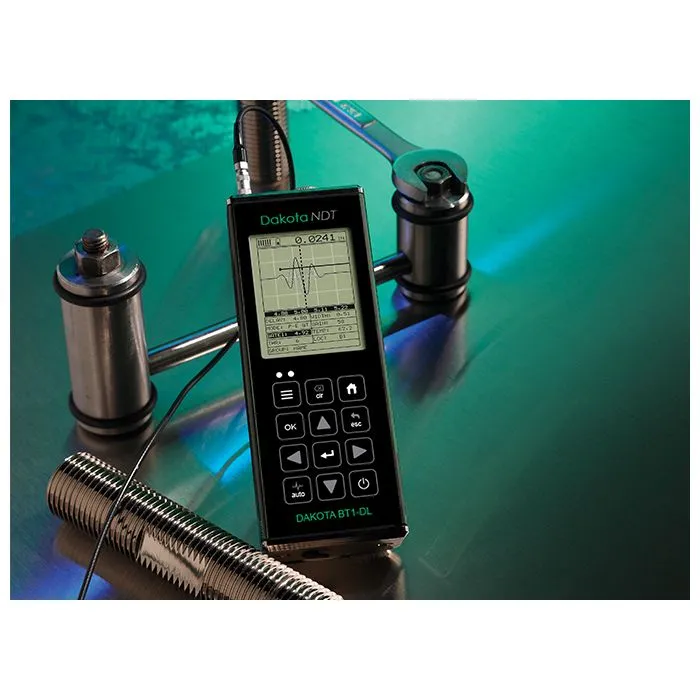
Controlled tightening of bolted flanges is one of the most delicate operations in the maintenance of pressure plant. The American standard ASME PCC-1 “Guidelines for Pressure Boundary Bolted Flange Joint Assembly” is the international reference that defines good practice for carrying out this operation safely and repeatably. The Dakota BT1-DL and BT2-DL instruments for ultrasonic bolt tension measurement are designed to support applications that require the level of control set out in PCC-1.

What is ASME PCC-1
ASME PCC-1 is a guideline published by the American Society of Mechanical Engineers within the Post Construction Committee (PCC) series, which gathers good practice for managing plant after construction. PCC-1 is specifically dedicated to the assembly of bolted flange joints on pressure boundaries. Its main contents include:
- Preparation of the flange sealing surfaces
- Gasket selection and verification
- Selection of bolts and nuts according to material, strength class and chemical compatibility
- Lubrication of the threads and the nut bearing surfaces
- Progressive tightening procedures (cross-pattern, tightening in passes)
- Methods for controlling the applied tension
- Qualification of personnel assigned to critical tightening (Bolted Joint Assembler)
- Documentation of the job

Need help choosing the right product?
Why controlled tightening: the problem with the torque method
The traditional method of controlling tightening is the torque wrench. Applying a known torque to the nut gives — in theory — a known tension in the bolt. In practice, engineering studies show that with torque wrenches the scatter in actual tension can reach ±25-30% of the nominal value, owing to:
- Variable friction between the threads and between the nut and the bearing surface
- Uneven lubrication
- Temperature variations during tightening
- First-tightening resistance (embedding)
- Gasket relaxation after installation
- Differing elastic deformation between adjacent bolts
In critical applications — flanges on pressure lines, refinery heat exchangers, turbine joints, reactor stay bolts — this scatter is not acceptable. PCC-1 recommends using more accurate control methods when the service requires it.
The ultrasonic method provided for by PCC-1

Among the more accurate tension control methods, ultrasonic measurement of bolt elongation — as implemented by the Dakota BT1-DL and BT2-DL — offers decisive advantages:
- Stated accuracy of 0.0001 mm (0.00001 inches) according to the official Dakota data sheet
- Insensitive to friction: it measures the effect (elongation), not the cause (torque)
- Not sensitive to temperature: built-in automatic temperature compensation
- Verifiable repeatability: the measurement can be repeated on the same bolt at any time during its service life
- Integration with progressive tightening: the evolution of the tension can be monitored in real time during the procedure
- Post-job verification: the tension can be checked even weeks after tightening to assess any relaxation
Typical controlled tightening procedure with the BT1-DL
A PCC-1 tightening procedure compatible with the Dakota BT1-DL typically involves the following steps:
- Measurement of the reference length (zero-load) of each bolt before tightening, with the Dakota BT set to Elongation mode
- Initial tightening to the torque value specified by the procedure (pre-load), following the cross-pattern set out in PCC-1
- Subsequent progressive tightening passes (typically 30%, 70%, 100% of the target torque)
- Ultrasonic measurement of the elongation at each pass, checked against the calculated target value
- Fine corrective tightening on bolts that deviate from the target
- Re-check after settling (typically 4-24 h)
- Documentation for each bolt: initial length, final length, elongation, calculated tension
Which Dakota model for which PCC-1 applications
- Portable BT1-DL: ideal for field work on process line flanges, periodic maintenance, heat exchangers and critical connections during plant shutdowns
- Benchtop BT2-DL: ideal for qualifying critical fasteners in the workshop, large fasteners (up to 30 m) and high-volume inspection laboratories
Personnel qualification
ASME PCC-1 pays particular attention to the qualification of tightening operators. The qualified Bolted Joint Assembler (PCC-1 Appendix A) must have received specific training on procedures, instrumentation and control techniques. Using an instrument such as the Dakota BT does not replace personnel training but enables it, providing the repeatable, documentable measurements on which the procedure is based.
For a demo of the Dakota BT instruments and for advice on bringing your tightening procedures into line with PCC-1, contact our technical department.