


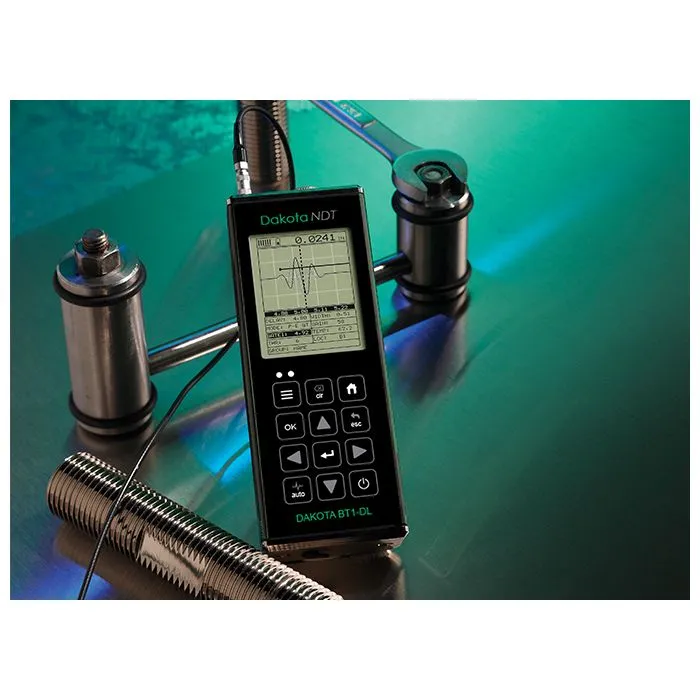
When tightening bolted flanges in pressure plant — refineries, thermal power stations, chemical processes, compressors, heat exchangers — a torque wrench on its own is not enough to keep the joint tight over time. The traditional torque control technique introduces uncertainties of ±25-30% in the actual bolt tension, which is unacceptable in critical service. The Dakota NDT BT1-DL and BT2-DL instruments use ultrasonic elongation measurement, independent of friction and temperature, with a stated accuracy of 0.0001 mm according to the official data sheet.

The technical problem with torque tightening
When a nut is tightened to a known torque, only part of that torque turns into actual tension in the bolt. The energy balance is typically:
- ~50% absorbed by friction between the nut and the bearing surface (the flange)
- ~40% absorbed by friction in the threads
- Only ~10% turns into elastic elongation of the bolt (the useful tension)

Need help choosing the right product?
This split depends on many variables that are hard to control in the field: lubrication, surface roughness, temperature, nut wear, flange quality, torsion of the bolt during tightening. The result is that two bolts tightened to the same torque can have very different actual tensions and, above all, drift progressively away from the nominal target.
The practical consequences
- Flange leaks: insufficient tension does not deliver the contact pressure the gasket requires
- Bolt fatigue: cyclic loads on under-tightened joints lead to fatigue failures
- Overload failures: tightening beyond the yield point causes brittle failures in service
- Relaxation after tightening: gaskets and bolts bed down after installation; without a repeatable measurement the residual level cannot be checked
- Flange distortion where tightening is uneven
- Unplanned plant shutdowns for corrective work
The principle of ultrasonic measurement

When a bolt is tightened it stretches elastically by an amount proportional to the tension applied (Hooke’s law). Measuring that elongation directly gives the real tension, with no dependence on friction or torque. The Dakota BT instruments send an ultrasonic pulse along the axis of the bolt, measure the return time of the back-wall echo and calculate the change in length to 0.0001 mm (0.00001 inch) — the figure stated on the official Dakota data sheet.
The ultrasonic technique has decisive advantages:
- Insensitive to friction: it measures the effect (elongation), not the cause (torque)
- Insensitive to temperature: automatic compensation is built in
- Repeatable over time: the same bolt can be measured months or years apart
- Non-destructive: it requires no modification and no strain gauge bonded to the bolt
- Verifiable after the fact: useful for diagnosis after an intervention where leaks appear
Typical applications on pressure flanges
- Refineries and petrochemicals: flanges on steam lines, process lines, heat exchangers and reactors
- Power generation: flanges on turbines, compressors, safety valves and penstocks
- Cryogenic storage: flanges that have to stay tight across wide temperature ranges
- High-pressure gas transport: flanged joints on gas pipelines and compressor stations
- Pharmaceutical industry: sanitary stainless steel lines with special gaskets
- Food and beverage industry: clamp and DIN flanges with hygiene requirements
Choosing the right instrument
- Dakota BT1-DL (MiniMax): handheld portable, ideal for field work, the periodic maintenance of standard flanges and tightening during a plant shutdown
- Dakota BT2-DL (Max II): benchtop, able to measure fasteners up to 30 metres long for special applications (tie rods, reactor stay bolts, anchor rods)
For a detailed comparison, see our article BT1-DL vs BT2-DL: bolt tension monitor, portable or benchtop.
The regulatory framework: ASME PCC-1
The international reference for the controlled tightening of pressure flanges is ASME PCC-1, which brings together good practice for preparation, lubrication, fastener selection, progressive tightening procedures and methods of tension control. Ultrasonic measurement is one of the methods PCC-1 recommends for critical applications. For a deeper look, see our article ASME PCC-1: controlled tightening of flanges.
For an assessment of Your critical tightening applications and for a demonstration of the Dakota BT instruments, contact our technical department.